Engineered to the drawing.
Not a catalogue: wear plate is a wear allowance, a load path and a bolt pattern before it is a material. We quote the build-up from your duty and your structure, then cut, drill and form to the drawing you send.
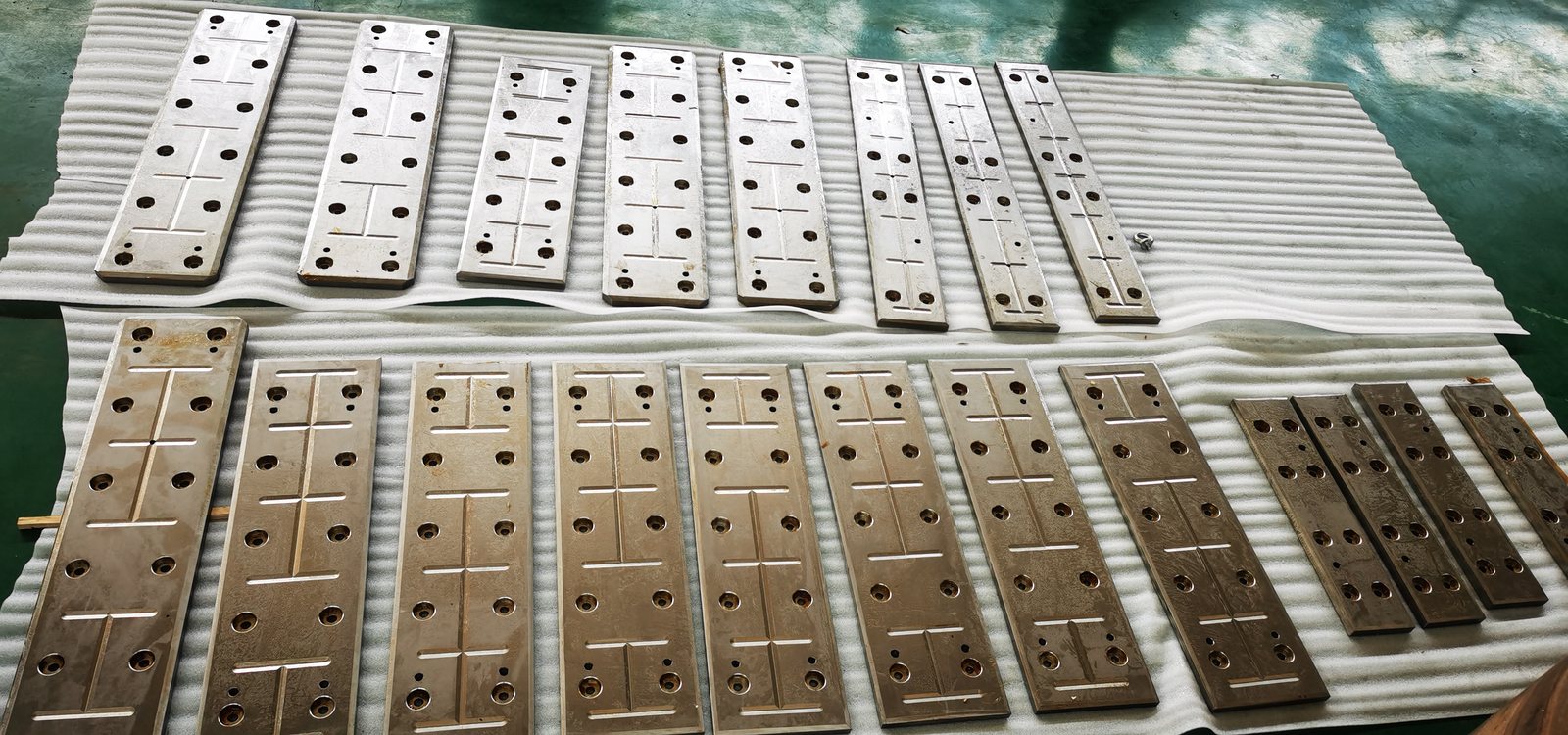
Three numbers decide whether a liner lasts
Not the grade name. The wear allowance, the bond and the hardness you can prove on the plate in front of you.
Three grades, one welding line
Standard wear
58-62 HRC wear face, 4-6 mm layer, carbon steel backing from 25 mm. Chutes, hoppers and transfer points under sliding abrasion.
Stainless backing
54-58 HRC wear face, stainless backing from 25 mm. Wet, salty or corrosive material where a carbon backing would rust out first.
Heavy impact
60-64 HRC wear face, 8-10 mm layer, backing from 32 mm. Coarse lumps, mill housings, bearing seats, structures that can carry the weight.
Where a drawing calls for a proprietary grade, send the hardness and case depth written on it. We check the section against those figures before quoting, and say plainly if the section will not hold.
Pick the build-up by what you are replacing
Two questions settle it: how long the old liner lasted, and how much weight the wall or bucket can carry. Everything else is detail.
| Build-up | Where it belongs |
|---|---|
| 4+4 mm | Light sliding abrasion, small chutes, low headroom |
| 6+4 mm | General chute and hopper linings, moderate impact |
| 8+6 mm | Coarse material, longer intervals between stops |
| 10+10 mm | High wear allowance, large lumps, heavy structures |
How an order runs
- Drawing and dutyOutline drawing or a photo of the worn plate with its overall size, the material handled, lump size, drop height and whether it runs wet or dry.
- Section checkWe check the build-up against the duty and the structure, then quote grade, thickness and weight.
- Welding and flatteningExplosion welding, then flattening and stress relief so the plate sits flat on the structure.
- Cutting, drilling, formingPlasma or waterjet cutting, drilled and countersunk to the pattern, rolled or pressed where the drawing calls for it.
- Inspection and packingHardness checked on the plate, dimensions checked against the drawing, plates marked and crated for sea freight.
Bulk material handling, and the places it eats steel
Send the drawing. We will send back a section.
A PDF or a phone photo is enough. We reply within one working day with the build-up, the weight and what we need to confirm.
Send an enquiry