Bimetal wear plate
A high-chromium wear face explosion-welded to a carbon or stainless backing, then finished to the drawing: cut, drilled, countersunk, rolled or pressed.
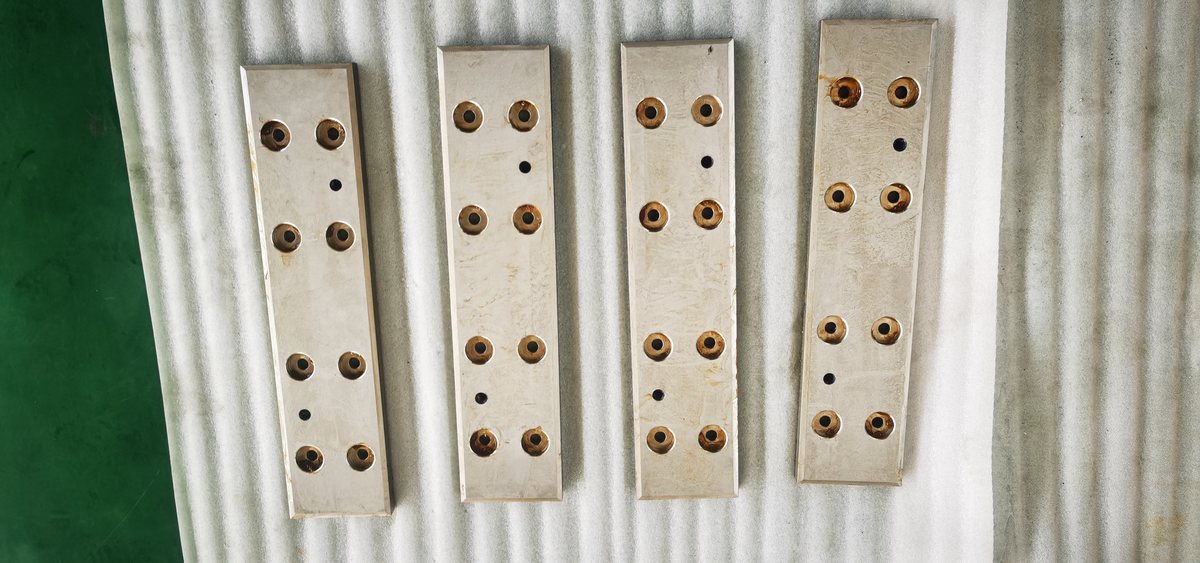
Specification
Values below are the working range for the series. The exact figure for your plate is the one written on its inspection sheet.
If a drawing names a proprietary grade, send the hardness and case depth on it. We check the section against those figures and tell you if it will not hold.
| Wear face | High-chromium white iron, our specification |
|---|---|
| Hardness | 54-64 HRC by grade, Leeb tested on every plate |
| Build-up | 4+4, 6+4, 8+6, 10+10 mm; other sections quoted to drawing |
| Backing | Carbon steel from 25 mm; stainless from 25 mm; heavy grade from 32 mm |
| Bond | Explosion welded; 500-600 N/mm² interface shear |
| Format | Flat plate, cut parts, drilled patterns, rolled or pressed liners |
| Tolerance | Dimensions to drawing; flatness checked before packing |
| Marking | Grade, heat and plate number on each piece |
Grades
| Grade | Wear face | Layer | Backing | For |
|---|---|---|---|---|
| BT-CW-B | 58-62 HRC | 4-6 mm | Carbon, from 25 mm | Sliding abrasion: chutes, hoppers, transfer points |
| BT-CW-BS | 54-58 HRC | 4-6 mm | Stainless, from 25 mm | Wet, salty or corrosive material |
| BT-CW-BE | 60-64 HRC | 8-10 mm | Carbon, from 32 mm | Coarse lumps, high impact, mill housings, bearing seats |
Bond strength is the same across the three grades. Chemistry and service life are not identical to any other maker's plate, and we will not pretend otherwise: the wear layer is our own high-chromium specification, and life depends on the duty.
What to send
Outline drawing
Or a photo of the worn plate with its overall size and the hole pattern, if the original drawing is gone.
The duty
Material handled, lump size, drop height, wet or dry, temperature at the liner.
The constraint
Thickness on the drawing, bolt size, hole spacing, and the weight the structure can carry.
Questions that come up before an order
What does 8+6 mm mean?
The first figure is the wear layer, the second is the backing plate, both in millimetres. An 8+6 plate is an 8 mm high-chromium wear face welded to a 6 mm carbon steel backing.
Should I specify the hardest grade available?
No. A very hard face cracks under heavy impact. That is why the heavy-impact grade pairs a harder face with a thicker backing, and why the backing is sized from the bolt and the load.
Can you match a grade named on a drawing?
Send the hardness and case depth written on the drawing. We check the section against those figures and quote against them, or tell you where the section falls short.
Curved liners?
Yes, rolled or pressed to the radius on the drawing. Send the radius and the chord length, not just a photo.
One drawing, one section, one weight.
We reply within one working day with the build-up and anything we need to confirm.
Send an enquiry